About Me

My photo
Tacoma, Washington, United States

Friday, May 27, 2016

Life in Hard Times


Chapter 4

…and the star skunk


During the early thirties it seemed as if the drought and Hard Times would go on forever.  The sun rose each morning into a clear blue sky and, long before noon, it was a brassy ball under which the heat became oppressive.  The red soil of our Ozark cornfields and that of the dirt country roads turned to powdery dust and, in summer, the corn shriveled more than it grew.  The cows spent as much time in whatever shade they could find as they did in grazing on the parched grass.
Walking through the woods in the heat of the day was like walking in church—a stillness because the squirrels were enervated and the many songbirds were muted.  Many times during those hot summer days the only sounds might be the distant ker-thump of someone’s hydraulic ram pumping water from a dwindling branch, the listless caw of a distant crow, or perhaps the plaintive call of a mourning dove.
Typical dress and method of clothes washing in the Ozarks 


When we moved onto the little farm spang in the middle of the drought years, not much of a living could be made on forty acres so Dad had to rent other land to try to grow corn and he often went out looking for other work.  Once, in the mid-thirties, he got some road work when the government was improving the dirt road through Bona to a “farm-to-market-road” and during that time he helped build new bridges over the Little Sac river north of Bona and over Maze Creek between Bona and Dadeville.  By the sweat of his brow and the labor of his strong arms, he kept some sort of food in the house and clothes on our backs—albeit often faded and patched which Mother kept clean with her washtub and scrub board.


Josie Stanley on porch in Bona, MO

I have already described Grandpa Stanley’s general store at Bona.  His house was just north of the store, across a grassy yard.  It was a white, two-story (one and half actually, as the upper floor with two bedrooms was an overgrown attic with dormer windows) farmhouse type building.  It had a small front porch that was covered on each side by a red climber rose.  The porch was just large enough for Grandma to sit in her rocking chair out there in the evening and piece quilt tops or tat lace (her small hands were never idle).  When I stayed with them, Grandpa and I would sit on the porch step after he closed the store for the night and he would sometimes get out his fiddle and play for us.  He was a good old-time fiddler and could really saw out a tune, all by ear and memory.  I especially liked his lively rendition of “Marching Through Georgia.”  Right there you know that he was on the side of the Union during the Civil War, although he could play “Dixie” and the old Stephen Foster southern songs with the best of them.  Most old-time fiddlers played with the fiddle resting on their chest, but Grandpa played in a more modern style with the fiddle tucked up under his chin.

Great-great-great-grandson of C. B. Stanley


I like to believe that somewhere Grandpa Stanley looks favorably on the violin ability of his great-great-great-grandson.  

C. B. Stanley on the porch of his general store, Bona, MO


The house and store sat on a big double corner lot and there was a small barn down in back that Grandpa used for storage and for a garage for his car and truck.  At one side of the barn, behind a large lilac bush, was the two-holer outhouse (big hole for adults and a small one for us kids).  On the other side of the barn was the kitchen vegetable garden.  Between it and the big back yard Grandma always had a row of tall hollyhocks.  She was very fond of flowers.  In the front yard there was a frame for roses, sweetpeas along the fence by the town row of mailboxes, and in the side yard a combined flower/herb garden.  A big black walnut tree shaded that east side of the house.
In my earliest memories, the northeast corner of the Bona crossroads was vacant and was used for a hitching rail for wagons and buggies coming to the store or to church; however, sometime around 1932 or so, my Uncle Hubert from Kansas City built a new store building there for Tom Humbert.  We did not trade there much as he was a competitor to Grandpa Stanley but, of course, we kids often hung out there.
Although gambling was a mortal sin, Tom Humbert one time put in a penny slot machine that some slick-talking traveling salesman talked him into.  It resulted in a lesson for us boys that gambling was a sin.  One afternoon my little brother Rex was at Humbert’s store and he had a penny.  He put it into that slot machine and won a small handful of pennies.  Rex was only about six years old so, naturally, marched proudly home and showed Mother what he had won.  She scolded him good and made him march right back down to Humbert’s store and give back the pennies because he could not take money won at gambling.  I think Tom did away with that little contraption shortly thereafter, most likely the church elders got on him about it.
(I guess that lesson took pretty well on Rex as I never knew him to do much in the way of gambling in later years.  It did not take too well on Richard and me, however, as when we were in VP-11 in the Navy he was known as a sharp poker player and I had an undeserved—I was just lucky at times—reputation as a crap shooter and poker player.  I still play poker with some of my old cronies, but only nickel, dime, and quarter pot limit.)

Thursday, May 26, 2016

Family Feud


Feuds are a part of the history and present in the Ozarks


The feud between the Hatfields and the McCoys is well known, but not unique.  Families in the Appalachian and Ozark Mountains have found things to disagree over and take to feuding in one form or another.  The book and movie "Winter's Bone" is a recent pop culture look at a violent feud, not over moonshine, but over methamphetamine which has replaced moonshining as a cottage industry in the Ozarks with far more devastating results.  Fortunately our family feud never evolved to anything like the Hatfields and the McCoys, but hard feelings lasted until all the principles were gone from this world.

I mentioned earlier that feuds have started over less than that old dog Hoover.  That is true.  These days a lot of people think that hill country feuds are just fables to sing about, like the Hatfields and the McCoys.  They are not fables.  We had a pretty good feud going right there around Bona in the early thirties.  As a matter of fact, because of the criss-crossing of families, we were related to both sides of the local feud.

That North Morgan township feud was between the Tygarts and the Asbells.  Coy Tygart had married my father’s sister Norma so he was my uncle and their children, two boys and three girls, were my cousins.  The oldest was Eldon, then there was Lee, Edna May, James Lowell (the same age as Richard), and Imogene who was a little younger than me.

On the other side of the feud was Henry Asbell.  Henry’s mother, Aunt Lizzie, was a sister of my grandmother, Josie Stanley (nee Blankenship) so that made Henry and Maud Asbell’s kids our first cousins once removed.  Evelyn Asbell was about Dick’s age and their son Gene was a year younger than me.

We stayed just about completely clear of the feud and as neutral as we could, although I’d reckon we favored the Tygarts a bit since they were closer relations than the Asbells.  Coy and Norma Tygart lived on the Frieze old home place where I had been born.  Henry and Maud Asbell lived on the next farm to the west just across a small valley and creek.  The two farms shared a fence line.

Coy Tygart was a proud and stubborn man.  Apparently he was a pretty good farmer as the Tygarts always had clothes a little better than some folks in those Depression days and a fairly good Model T Ford to drive to town.  I found out in later years that, actually, my father harbored a grudge against Coy because of the way he treated my Aunt Norma—keeping her in the kitchen most of the time, hardly ever letting her talk, and Coy practically never took her to town with him, or any of the girls either.

Coy Tygart was to outlive Norma.  He lived to be 92 years old and spent his last years in a little house in Tulsa, Oklahoma.  He was a tough old bird (like most Ozark men), lived by himself, and made a garden every spring right up to the time he died.  One morning in about 1985, James Lowell’s wife tried to call Uncle Coy and there was no answer.  She went to check on him and found him sitting upright in his chair at the dining table, but he was stone cold dead.

My father was then nearly 90, had been given up for being terminal a couple of times, and was pretty frail.  When I told him the news about Uncle Coy and how he died, Dad sat with his hands folded on his cane, thought about it, then simply said, “Just like Coy Tygart.  Too damn stubborn to lay down!”

To get back to that feud, Henry Asbell was quite a bit different from Coy Tygart.  Coy was a tall commanding figure.  Henry was a short little fellow with sometimes a weasely look about him.  He had the reputation for being a natural born thief and, according to some of the things my father told me in later years, the reputation was well-earned.  Henry was quite a woodsman and was always out hunting possum, skunks, raccoons for their hides.  He was not much of a farmer and I believe lived more by his wits than the sweat of his brow.

Henry Asbell also made moonshine both before and after Prohibition and used to keep some bottles of it in a gunny sack in the spring down the bluff below their house.  I know that because more than once we boys swiped a bottle or two to see what it was like.  I did not care much for it as it tasted bitter to me.

I also know from experience that Henry was a sneaky devil.  He could go through the woods in the night without making a sound.  One black night when we had gotten a little older, Richard and I were out possum hunting deep in the woods, quite a way form Henry’s house.  We thought we were pretty good at not making noise and were moving along quietly when Dick saw a shadow move and turned on the flashlight.  There stood old Henry grinning at us.  He just waved and vanished silently into the brush.

Well, I seem to keep getting off the subject of the feud.  I have never been too clear on exactly how the Tygart/Asbell feud got started, but it had to do with the fence line between the two farms.  One or the other of them was feeding turkeys at one time in a field near the fence and the other one’s pigs would get through the fence and eat shelled corn left for the turkeys.  Then a pig disappeared and nasty things started to happen.  I am fairly sure that Coy accused Henry of stealing a pig.

It never quite escalated into a shooting feud, thank goodness, and all in all it was really sort of funny, but they sure did some mean things to one another.  One night my father was in Greenfield with Coy Tygart and I reckon they had been drinking some.  It seems Coy spotted Henry Asbell’s Model T sitting on a street near the square, pulled out his pocket knife, and slashed a couple of Henry’s tires.  Henry saw them and got hold of the sheriff.  I do not know the details, but believe they may have spent a night in jail.

Even though my father had no part in slashing the tires, he was with Coy and that nearly drew us into the feud.  One night a trammel net (for catfish) that belonged to Dad disappeared.  He was pretty sure old Henry had snaffled it, but being slow to anger and a peaceable man, Dad did not accuse Henry.  Instead, that Saturday afternoon Dad was at the store in Bona and he told some people that were around about it and added, “I reckon I know who did it and, he don’t bring that trammel net back, I’m gonna go after him!”  The next morning the trammel net was in a gunny sack, hanging on the fence along our yard.

Not long after that, Henry decided that he would not share a fence line with Coy Tygart so he went to work and built a new fence all along his farm (a quarter of a mile of fence) three feet back from the old fence and forming what was known as a “Devil’s Lane.”  Being (as I said) a stubborn man, Coy Tygart allowed as how he would not use that line fence either and he built one three feet back on his side.   That Devil’s Lane, claimed by neither man, just few up in brush and made a dandy place for James Lowell to set his rabbit traps.

The Devil’s Lane was still there when I visited Bona not too long after WWII, but a few years later the Tygarts moved away, Henry Asbell bought the Frieze old home place and tore the fences down.  Unfortunately, Henry let that proud old farmhouse go to wreck and ruin and now my birthplace is falling down.

In researching the idea of a Devil's Lane I discovered that they were a method European settlers brought to the South and the Ozarks to settle land disputes.  A lot of those lanes have become actual streets and roads where houses have been built.  I don't think I would like Devil's Lane as an address.

I believe that the only time anyone actually got injured in that feud was in the late thirties after we had moved out to Vancouver, Washington again.  My brother Richard was in Missouri visiting not long before he joined the Navy.  He and James Lowell went to a baseball game at the Bona town ball field one hot Sunday afternoon.  Now I do not know if they had anything to drink and they would not admit it if they had, but during the ball game James spotted Henry Asbell crouching down over along the third base line watching the game.  James picked up a sizeable piece of sandrock and tucked it inside the bib of his blue overalls.  He and Richard moseyed around the ball field until they were right behind Henry then James whipped out the rock and broke it over Henry’s head.

I was not there, but I guess it really laid old Henry out and cut his scalp pretty bad.  I imagine that James and Dick lit out for the brush before anyone could catch them and I suspect that they may have hid out in a “secret” cave over to the west along Maze Creek that we knew about.  (I must remember to tell you about that cave and how we found it later on.)

I do not know how it all came out for James in the long run, but that was just about the last incident in the Tygart/Asbell feud.  Most of the time it had just been hard feelings between the two families so it really did not amount to all that much.

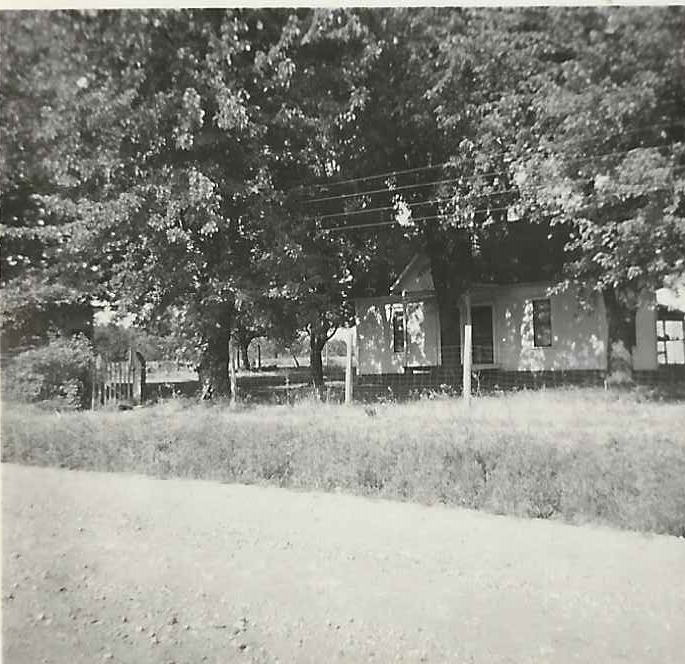
In these early chapters I have probably missed some of the places where we lived when I was small, but I guess that is not important.  The ones I have mentioned were the principal ones that I remember before we moved into the little three-room house just a quarter mile south of Bona which would be our last home in the Ozarks.
Last Missouri home of the Ernest Frieze family

My Grandpa Stanley bought a forty-acre farm there south of Bona and Dad moved us onto it to share crop.  That would have been in 1933 when I was eleven years old.  The great drought and dust bowl were in full swing, the Okies were heading down Route 66 to the promised land of California, and Hard Times seemed to go on and on.

When we all gathered in Vancouver for my grandparents’ 40th anniversary, my aunts and uncles sat with my grandparents around the kitchen table and counted up how many houses they have lived in by then.  After forty years of marriage they had lived in 42 houses.  I can’t remember which house that was in, but I think it was Minnehaha.  From there they would move to Whidbey Island, thence to Bolivar, MO, and to Greenfield before coming back to Washington for the third time and landing in Bellevue to be near my Aunt Sandra Hard.  So in the end, to the best of my knowledge, they shared about 45 homes in sixty-five years.

Wednesday, May 25, 2016

Ain't Nothin' But a Hound Dog


Another thing I recall about the time in that yellow house is when I wound up with egg on my face—literally.  It was in the winter when everything was frozen.  The chickens were watered in an old wash pan and, of course, that froze. 
One Saturday after noon, long after the episode of the itch, we were going to go to Bona.  When we got ready to go I had forgotten that I was supposed to take the hot teakettle off the kitchen stove and thaw the water pan for the chickens.  Just as we were getting into the Hupmobile, my mother asked about it.
I ran back and got the boiling kettle off the wood stove.  In my hurry to get going to Bona, I raced through the back yard toward the chicken house and tripped over a big root from a maple tree.  I and the tea kettle hit the frozen ground at the same time.  The lid popped off and the scalding water splashed over my arm and one side of my face.
I probably near raised the dead in the next county with my howling.  My mother came running and, as usual, she knew what to do.  She hustled me into the house, broke some eggs and separated the yolks, then smeared the egg white on my face. 
I felt pretty silly walking around with that dried egg white on my face.  For years I thought about that every time I heard the expression “…and there he was with egg on his face.”  Either I was not burned all that bad or else my mother’s treatment was just right because the burns healed in a few days and did not leave any scars.  I always had a healthy respect for water after that, but being a dumb old country boy, I kept getting into “hot water” one way or another for the rest of my life.  And sometimes got “burned.”
I researched this home remedy and found it to be part of the training for firemen.  Absolutely my grandmother knew what she was doing.  The natural collagen in the egg white helps to heal the burn.
We lived in that yellow house for a year or so, then Dad moved us into a big white farmhouse about half a mile south of Bona.  It was also up a long lane from the road to Dadeville.  In fact, from the white house you could see the yellow house we had lived in a quarter of a mile away across acouple of pastures.  After we moved, a very distant shirt-tail relative, Kaz Shouse, moved into the yellow house with his family.
The big white house we had moved into belonged to Fred Hulston who was the Chevrolet dealer in Ash Grove over toward Springfield.  I do not believe we lived there very long as I do not remember much about that place as some of the others.  One thing I do remember though, was an incident about an old hunting dog named “Hoover.”
Possum hunting was a fall pastime in the Ozark hills and a little money could be made at it.  The fur dealers that came through occasionally would pay a dollar or a dollar thirty-five or so for a good possum hide.  They were dyed and made into cheap fur coats or coat collars.
The time for possum hunting was in the fall after the first frosts and when the persimmons were ripe.  It was done at night when the possums came out to climb the low persimmon trees for the fruit.  Their fur was thick for the winter by then.  All that was required was a good flashlight with which to spot the possums in the low trees.
A good possum dog makes the hunt much more certain.  The dog would sniff out the possums and bark to let the hunters know which tree he was in.  The possum can then be shaken or knocked out of the tree.  They seldom run when they hit the ground, but usually just curl up and play dead.
Well, old Hoover was a real good possum dog.  He was smart enough to not go off chasing rabbits or to tree a skunk.  The dog belonged to an old widow who was a relative of ours.  One time the old lady told my father that she wanted him to have old Hoover.
When the old lady died, Dad went to get Hoover only to find that Kaz Shouse had already taken the dog and claimed that it had been given to him.  I do not know who was right, but I know that my father was quite peeved about it and threatened to go over to Shouse’s and get the dog.  My mother did not want to see trouble started over an old possum dog (feuds have started over less) so she talked him out of it.
The morning after I had heard my father talking about it, I took little brother Rex with me and took off across the fields.  When we got to Shouse’s I found old Hoover tied up in the alleyway between the house and the smokehouse.  With Rex at my heels, I just marched up and started to untie the dog.  Just then one of the Shouse girls, Hazel (who later married my first cousin Carl Frieze) saw or heard us and came out the kitchen door.  She knew that her father would be pretty riled up if I took the dog so she set about talking me out of it.
“Conrad,” she said, “it will just cause trouble if you take that dog and you don’t want to cause trouble now do you?”
“Well,” I stated flatly, “my daddy says that the old lady gave Hoover to him and my daddy don’t tell no lies.  I’m agonna take him home with me.”  Meanwhile I kept pulling at the knot in the rope.
“Now just a minute,” Hazel said.  “It is just your dad’s word against my dad’s and you don’t know which one is right.  You let them settle it.”
“Dadgummit,” I said emphatically, “my daddy don’t lie and Kaz Shouse don’t have a very good reputation for tellin’ the truth!” (That was true, but I had not stopped to think that I was talking about her daddy.)
Hazel got downright indignant about that.  She jerked the rope out of my hands and pointed across the fields at our house.  “Now that’s about enough, Conrad.” She snapped.  “You and Rex Donald just get right along home and don’t you come near this dog again!”
A family gathering in Bona.  Richard is center with the hat, Conrad bareheaded next to him, Rex the little boy in shorts and cap.  My grandmother is in the cloche hat and white dress to the far right, her sister (we believe) in the dark dress and standing next to her, and their father over their shoulders between them.

Rex was already backing away because Hazel was a pretty big girl and probably in her late teens at the time.  I stood there fuming for a minute then, in exasperation, kicked a piece of sand rock against the smokehouse wall hoping it would bounce and hit her accidental like—only it didn’t.  My dander was up, but there was no way I would fight a female so I turned around and marched truculently away—feeling ashamed that I had let an old girl face me down.  Later on I decided it did not matter much as Hoover was pretty old and I think he died not long afterward.
When I was born in Wichita both of my grandmothers lived across the country in Vancouver.  It was Carl and Hazel that came and stayed with my parents at first so I expect that my father had gotten over his resentment over old Hoover!


Tuesday, May 24, 2016

He Ain't Heavy, He's My Brother


1927 Hupmobile
This next house was forever known as "the itch house" in family lore.


At the time we moved into the yellow house (I forget who owned the property) Dad had somehow acquired a big old Hupmobile sedan.  It was black and square as a barn.  Matter of fact, that old Hup looked like a hearse.  With money short to non-existent, we did not have the Hupmobile very long.  As I recall, Dad sold it to my Uncle Merritt Stanley who by then was running a garage and filling station in Aldrich, Missouri, seven miles to the east of Bona.  My Uncle Merritt cut the back of the body off and made a pickup truck out of that big old car.
One thing I remember about living in that yellow farmhouse was that it sure was a long way to walk to school.  Bona School was on a hill a full mile north of Bona so us kids had about a two-mile walk each way.  That is not far in a car, but it was a long way on shank’s mare.  We did not really mind, however, as walking to school was a way of life.

That walk really worked a hardship on little Rex because his legs were so short.  He did not have much trouble keeping up because Richard and I normally left in time that we could just mosey along, but coming home after playing hard at recess, Rex’s legs would sometimes give out and he got leg aches.  Sometimes he would just sit down in the ditch and cry, they hurt so bad.  I am afraid that we often gave him a hard time about keeping up, but I could remember getting leg aches when I was little so I would hoist him onto my back and give him a piggy-back ride home.
My mother, Eva, sure had a terrible experience while we lived in that big yellow house.  We kids caught the itch—no doubt at school because the Lord knows Mother kept us clean enough at home—and Dad caught it from us.  It sure was aggravating to be itching all the time and you were not supposed to scratch, but it was my mother I felt sorry for.  She slaved for several days carrying water from the well for the washtub she heated on the kitchen stove to scrub us and all our clothes.  She must have used a short ton of pine tar soap and I believe she doused us with calamine lotion.
Polkberry

We felt like lepers because we could not go to school with the itch, but eventually Mother got us all cured and we stayed home a couple of more days to make sure it was gone and no one would catch it from us.  We were happy as turkey gobblers in a polkberry patch when we finally got to go to Grandma’s at Bona one evening, then went back to school.
1927 Hupmobile
That first trip to Bona after the itch did not work out too well—in fact that was one of the last times I saw my mother cry.  We drove up in the old Hupmobile and Mother went to the door to make sure that is was alright with Grandma and Grandpa if we came in.  Unfortunately, she came back to the car weeping and we turned around and went home.  It was not Grandpa and Grandma Stanley’s fault, however.  My Uncle Merritt and Aunt Golden from Aldrich were there visiting.  When my mother asked—and before Grandma could answer—my aunt exclaimed, “Well! I sure don’t want to catch the itch!”
My mother just turned away and came back to the car.  I guess I never quite forgave my Aunt Golden that she had made my mother feel bad and cry after she had worked so hard to cure us all.

I’m not sure that my father ever heard “He Ain’t Heavy, He’s My Brother,” but whenever I hear it I think of him carrying his brother when he couldn’t make it make it on his own.  The Frieze kids were like that.  As an only child, they were my template for how siblings were.  I have since learned that is not always the case.  My father loved his family desperately as you will see.  I believe that anyone of them would have literally carried the other…well, not my little Aunt Sandra, but anyone of her brothers would have gladly carried her.  In the end, isn’t that the reason we are here?  To carry one another when we can?
 And at the heart of it all was my grandmother.  She raised four children during the Great Depression and, with a husband who had "sand in his shoes," she had to learn to travel light; to figure out what was worth carrying.  She travels with me in my heart and head and I believe I miss her most of all.


Monday, May 23, 2016

Chapter 3: Back to Bona


Chapter 3
More Moves and a Feud 
The crops did not amount to much that year on Doc Hunt’s place as the big drought of the thirties was getting underway and Hard Times were in full swing.  My father put his seed corn and his hopes into that worked-out red Ozark soil, but neither came to much.  He gave up renting and went back to tenant farming in 1931 or thereabouts.
This time we moved into a big yellow farmhouse about a mile south of Bona and a quarter of a mile off the road to Dadeville.  In all of our moves in those days we kept getting a little closer to that little store was there, is why I feel that Bona (such as it is) is my home town. [village would be a better term]
That yellow house was up a long rocky lane from the county road.  At that time the county road was just a rocky dirt country road.  There were no bridges over Maze Creek, halfway to Dadeville, or over the Little Sac River, south of Dadeville near Tarrytown.  In either wagon or car, it was necessary to ford the streams where rocks and gravel had been filled in to make a shallow riffle for the road to cross.
Richard and I were old enough by then to ramble around the countryside exploring and we really began to appreciate the beauty and peace of those Ozark hills.  It is an area of gently rolling hills, extensive green woodlands, creeks, and river.  There are no mountains in southwest Missouri.  The “Ozark Mountains” that you hear about—really just overgrown steep hills with lots of woodlands and deep ravines—are mostly in southeast Missouri and down into Arkansas.
I don’t like my father’s term “overgrown’ hills.  As an adjective, it is the opposite of what is happening to the Ozarks Mountains.  What Uncle Dick told me, and I believe him, is that the reason the Missouri Ozarks Mountains, particularly those in the area our family is from, are the oldest mountains in the world.  Some people believe that the Appalachians (where our family passed through) are the oldest, but they are taller than the Ozarks. Like old people, the Ozarks have become worn and stooped from the millenniums of years since their birth, but their spirit is strong, but by 1931 the soil was worn out.  When I am there I can feel the ancientness.  Whatever those mountains may seem to suffer when compared to our Cascades or the Himalayas they make up for in spirit.  Too, whoo whoo for you?  Go there.

Those Ozark hills, however, were a veritable wonderland to us.  The deep woods—interspersed with cornfields, grain fields (wheat and oats), and open pastures—were mostly deciduous trees that were thick-leaved and shady in summer and bare in winter.  There was little underbrush in those woodlands so we could roam freely through them.
Fox Squirrel
The hills at that time abounded with small game.  Besides the many cottontail rabbits, grey squirrels and fox squirrels, there were quail and ducks in the fall.  There were more song birds than I can count: mocking birds, whippoorwills, cardinals, scarlet blackbirds, and many many sparrows.  There were many crows and (as scavengers to keep the countryside clean of carrion) turkey buzzards that wheeled silently in the blue sky.
We had plenty of catfish in the rivers and creeks as well as perch, bluegills, and chubs so us kids grew up with a fishing line and cork bobber in our back pockets.  It seemed that we always had new territory to explore and yet, in retrospect, I realize that our real world lay within a circle around Bona of about four miles in diameter.  Anything outside that was alien territory and any person—other than relatives—from outside was a “stranger” upon whom we looked with a bit of suspicion.
In the halcyon days of roaming those hills and woodlands, squirrel rifle in hand and fishing line in pocket, we came to know that home territory so intimately that we could find our way unerringly home even on moonless nights with only the familiar star constellations to guide us.
No matter where they roamed, the stars always seemed to guide members of the family back to Dade County.

Sunday, May 22, 2016

Rabbit traps, Caves, and Cannon


Another thing my father and his brother had in common with Tom Sawyer were the caves that are part of the Missouri landscape.  Like Tom, they explored those what were near where they lived.
The time we were living on Doc Hunt’s place was at the beginning of the Great Depression of the 1930s.  No one in the Ozarks knew much about national economics and such—at least not in our neck of the woods—but we sure knew that times were getting hard and money was mighty scarce.  That is what we called those days—“Hard Times.”

There was practically no way for youngsters to make spending money during Hard Times except for trapping rabbits.  The countryside was full of cottontail rabbits and dealers from the city would buy rabbits in the fall when the weather was cold enough for the carcasses to keep after they were killed.  We could trap rabbits, kill them by breaking their necks, gut them, and sell them at the store for ten or twelves cents apiece.  The city dealers would come by once a week or so and buy the rabbits—the carcass for meat markets and the skin for making cheap fur coat collars.

We used box traps to catch the cottontails.  They were wooden boxes about twenty inches long made from pieces of board six and eight inches wide.  There was a vertically sliding door at the front.  Two holes were drilled on the top; one for a forked stick for a fulcrum and the other at the rear for the trigger.  The trigger was connected to the sliding door by strings and a log stick levered over the fulcrum so that when the trap was set the trigger held up the sliding door.  The trap was baited with an apple core or carrot.  When the rabbit went in after the bait and bumped the trigger the door came down and he was caught.
Author's sketch of the kind of rabbit trap he and his brother made.


Richard and I usually had six or eight box traps.  In thickets and fence rows we would find the little paths where the rabbits travelled and set the traps where they would not miss them.  In rabbit season in the fall, we ran our trap line every morning and each evening—killing those we had caught and re-baiting the traps.  We never worked very hard at it, but we would often have three or four rabbits a week to take to the store.  When we got old enough to carry a 22 squirrel rifle, the rabbit money enabled us to buy shells for the slender little Remington rolling-block single-shot rifle that Dad got for us when I was ten.

Richard and I were to grow up carrying that little squirrel rifle while we roamed the fields and woods.  Dad taught us to handle it safely and how to aim with deadly accuracy.  He taught us never to aim a gun unless we intended to shoot and to shoot straight.  His philosophy was, “if you can see it, you can hit it.”  When we killed a squirrel, for instance, we did not just shoot at the squirrel.  We shot at his eye.  We killed squirrels only for meat for the table and shooting one through the body tended to spoil the meat.  If we could not see the head, we did not shoot.

Once in a while, of course, we would accidentally gut-shoot a squirrel.  When that happened to me (which was not often, I am happy to say) I would bury a badly gut-shot squirrel rather than be embarrassed by taking one home that I had not shot in the head.  I know that Richard occasionally did that also, although he seldom missed.  He was always a shade better than I was.  In fact, I saw him competing successfully in adult turkey shoots when he was only fourteen and I have known him to knock down a quail on the wing with that 22 rifle.  Of course I insisted the latter had to be an accident to be an accident!

That, however, was later on as in 1930 we were still not allowed to carry a rifle.  Instead, we had to be content with trapping rabbits, fishing, and just roaming the countryside exploring.  We found our first cave along the creek north of the Doc Hunt place.  We had been fishing with a neighbor boy who was two or three years older and were moseying along the creek bank under the trees along the base of a limestone cliff when we spied a dark opening about three feet high.  We hiked back across the fields to the neighbor’s house, borrowed a coal oil lantern, then went back to explore the cave.

It was a dandy cave.  The narrow passageways back into the cliff a few feet then widened into a low room maybe eight feet across from which two passageways led off into the limestone.  We could go no farther, however, as the openings were too low to crawl into.  The only thing unusual we found was a small glossy blue and green stalactite to carry home in my pocket.

Our father gave us another lesson about that.  When I proudly showed him the piece of stalactite, he turned it in his hands then explained to us how those stalactites take hundreds of years to form from water dripping through the limestone.  I felt bad then about damaging it and even thought about taking the piece back and gluing it into place but I never got around to it.  The result was that I never again thoughtlessly destroyed any sort of natural wonder.

That was the summer we made a steam cannon and could have gotten badly injured in the process.  We were fooling around with the same older neighbor boy (whose name I cannot recall) and came across an abandoned old broken-down blacksmith shop.  There were some dandy pieces of junk piled out behind the weathered old building and one of them was a piece of iron pipe about ten or twelve feet long.  It was capped at one end.

The neighbor boy proposed that we make a steam cannon and he proceeded to show us how.  The pipe was about three inches in diameter.  We spent about an hour cutting a plug from the end of a tree branch that would fit tightly into the open end of the pipe.  That done we built a fire and got it going good while we carried some water from the creek in an old bucket and filled the pipe about half full with it.  We then drove the wood plug tightly into the pipe, stacked up some rocks and propped the pipe up at an angle with the lower half across the fire.  The idea was to boil the water until steam pressure built up enough to blow out the plug.  Hopefully it would blow out before the pipe exploded.
It is possible the boys had seen an ad like this.


It took quite a while for the steam pressure to build up.  I got tired of just sitting waiting and was wandering around when finally, there was a satisfying BOOM!  The pipe jumped and fell off the rocks, and we could hear the wooden plug screaming off into the distance.  In later years during my engineering courses at the University of Washington I realized that we were lucky that we had not driven that plug into the pipe too tightly because the old rusty pipe could have exploded from the steam pressure and sent shrapnel flying in all directions.  At any rate, it was a very satisfactory experiment, but we never got around to trying it again.

The lessons of the Doc Hunt place would come together in the future when team work, creativity, shooting skill, and a large measure of grace would protect the Frieze boys.

Saturday, May 21, 2016

Finding a Vocation in a Cornfield


That summer on the Doc Hunt place, Richard and I were getting big enough to start helping with some of the farm work.  Richard, being nearly two years older, was still a little bit bigger than me, but not by much.  I was growing and catching him fast.  As an adult I would pass him in height and weight.
Richard was developing into a small edition of our father.  He was dark-haired like Dad and we boys all had the Frieze blue eyes.  Richard had a quick, keen mind and, even in those days, he was forever figuring out how to make things come out to his advantage.  He was always and forever trying to take advantage of me—too often succeeding.
I did not start out as if I were going to be very tall.  I was a chubby-faced little fellow with blond hair that tinged with red to a sort of copper as I got older.  I probably looked like a typical Dutch boy, thanks to my Blankenship ancestors. [Later life Richard traced the family history and discovered that the Blankenships were actually from England—descended from a knight no less.]
Both Richard and I had pretty fair tempers, but his was more slow-fused than mine.  When he got mad it would burn inwardly for a bit before he acted.  Not me.  Boy, when something got my dander up I would literally explode.  Of course that meant that oft times I would go off half cocked.
Most of the time I was far more happy-go-lucky than my older brother.  I did not have the devious streak Richard sometimes displayed and, consequently, got taken advantage of regularly.  I tended to take things and people at face value without looking for hidden motives.  I’d have to reckon that I was more than a little naïve.
Like normal brothers, Richard and I grew up fighting fairly frequently—both verbally and physically.  It helped develop some pretty tough muscles—not to speak of vocabulary (not necessarily the kind Mother would approve of!).  We also developed a closeness that made us defend each other, too.  We might be fighting as if we were determined to kill on another, but if someone else interfered we would turn on him and fight side by side.
At times we cooperated fairly well.  I remember when we first started plowing corn with a walking cultivator there on the Doc Hunt place.  Neither of us were big enough to handle the team and control the cultivator handles at the same time.  Dad, however, found a way that we could help.  He took an old metal farm implement seat and nailed it to the tongue of the cultivator at the base.  One of us would sit up there and drive the mules while the other walked behind and held the cultivator handles.
Type of mule drawn cultivator used in the 1920s & '30s

It was a pretty good system except that Richard was forever maneuvering to make it my turn at the handles when we were plowing the cross rows.  No matter how carefully Dad handled the trip wire for the corn planter, the cross rows were seldom nice and straight.  Maneuvering those cultivator handles so as not to plow up some corn sure put muscles into my arms and shoulders.  I suspect that was one reason that it was not too long before I could hold my own in a tussle with Richard—except when he and Rex ganged up on me.
Another chore we got acquainted with that year was replanting corn.  Replanting was the spring bane of every farm boy’s life.  The problem was that quite frequently when the corn came up there would be missing hills.  Since we wanted a full field, the missing hills had to be replanted by hand while the corn plants were small.
It was a deadly monotonous chore.  The equipment was a hoe and a pocketful of corn.  The replanter had to walk every row.  Where there was a missing corn plant you made a hold with the hoe, dropped in two or three grains of corn, and covered them up.  It got to be so mechanical that you could replant corn and think of other things at the time time—such as how you’d rather be fishing or swimming in the creek.  Quite often during those long sessions in a hot cornfield I would think about things I had read.  I was always an avid reader—anything I could get my hands on, but mostly pulp magazines with stories about cowboys and about the flying aces during the World War (later to be called World War I).
I remember one very hot day when I was out in the middle of the cornfield in my blue bib overalls, raggedy straw hat, bare feet, with my hoe.  An airplane came from the direction of Kansas City and flew right overhead.  You did not often see an airplane in those days and especially at fairly low altitude so, of course, I leaned on my hoe to watch.
It was a biplane with bright yellow wings and dark green fuselage.  I pulled off my straw hat and waved it.  By golly, the pilot saw me, waved back, and rocked the wings from side to side.  I was entranced and knew then and there that I had to fly someday—little dreaming that I would spend my entire life in and around airplanes.
WWI French Spad
I never have put much stock in astrology, but I was born on March 3rd which makes me a Pisces.  There may be something to it because, supposedly, Pisces are great daydreamers.  I used to dream up some pretty good fantasies while I plodded the hot, dusty cornfield rows, replanting corn.  I could literally leave those Ozark hills in my imagination.
Instead of faded blue overalls, bare feet, and a battered old straw hat, I would suddenly be wearing leather boots, coat, helmet and goggles, and with a white scarf fluttering in slipstream while I flew a Spad [French fighter plan of WWI] in a dogfight with a red Fokker triplane over the shot-up fields of France.  Other times I was dressed in black with silver ornaments on my wide-brimmed sombrero while, riding a coal-black stallion, I chased Mexican bandits.  The whole time that hoe would keep up its rhythm—click, plup, swish—click, plup, swish—wherever there was a green corn shoot missing.
My father enjoyed building model airplanes even as an adult.  You would think he got enough helping to design and sell the real thing.  Together we built a bi-plane model that he insisted we paint the colors of the one he’d seen that day in the cornfield. Additionally, my whole life my father loved Charles Schultz’s “Peanuts” comic strip.  I believe that he thought he and Snoopy had something in common.