About Me

My photo
Tacoma, Washington, United States

Saturday, May 21, 2016

Finding a Vocation in a Cornfield


That summer on the Doc Hunt place, Richard and I were getting big enough to start helping with some of the farm work.  Richard, being nearly two years older, was still a little bit bigger than me, but not by much.  I was growing and catching him fast.  As an adult I would pass him in height and weight.
Richard was developing into a small edition of our father.  He was dark-haired like Dad and we boys all had the Frieze blue eyes.  Richard had a quick, keen mind and, even in those days, he was forever figuring out how to make things come out to his advantage.  He was always and forever trying to take advantage of me—too often succeeding.
I did not start out as if I were going to be very tall.  I was a chubby-faced little fellow with blond hair that tinged with red to a sort of copper as I got older.  I probably looked like a typical Dutch boy, thanks to my Blankenship ancestors. [Later life Richard traced the family history and discovered that the Blankenships were actually from England—descended from a knight no less.]
Both Richard and I had pretty fair tempers, but his was more slow-fused than mine.  When he got mad it would burn inwardly for a bit before he acted.  Not me.  Boy, when something got my dander up I would literally explode.  Of course that meant that oft times I would go off half cocked.
Most of the time I was far more happy-go-lucky than my older brother.  I did not have the devious streak Richard sometimes displayed and, consequently, got taken advantage of regularly.  I tended to take things and people at face value without looking for hidden motives.  I’d have to reckon that I was more than a little naïve.
Like normal brothers, Richard and I grew up fighting fairly frequently—both verbally and physically.  It helped develop some pretty tough muscles—not to speak of vocabulary (not necessarily the kind Mother would approve of!).  We also developed a closeness that made us defend each other, too.  We might be fighting as if we were determined to kill on another, but if someone else interfered we would turn on him and fight side by side.
At times we cooperated fairly well.  I remember when we first started plowing corn with a walking cultivator there on the Doc Hunt place.  Neither of us were big enough to handle the team and control the cultivator handles at the same time.  Dad, however, found a way that we could help.  He took an old metal farm implement seat and nailed it to the tongue of the cultivator at the base.  One of us would sit up there and drive the mules while the other walked behind and held the cultivator handles.
Type of mule drawn cultivator used in the 1920s & '30s

It was a pretty good system except that Richard was forever maneuvering to make it my turn at the handles when we were plowing the cross rows.  No matter how carefully Dad handled the trip wire for the corn planter, the cross rows were seldom nice and straight.  Maneuvering those cultivator handles so as not to plow up some corn sure put muscles into my arms and shoulders.  I suspect that was one reason that it was not too long before I could hold my own in a tussle with Richard—except when he and Rex ganged up on me.
Another chore we got acquainted with that year was replanting corn.  Replanting was the spring bane of every farm boy’s life.  The problem was that quite frequently when the corn came up there would be missing hills.  Since we wanted a full field, the missing hills had to be replanted by hand while the corn plants were small.
It was a deadly monotonous chore.  The equipment was a hoe and a pocketful of corn.  The replanter had to walk every row.  Where there was a missing corn plant you made a hold with the hoe, dropped in two or three grains of corn, and covered them up.  It got to be so mechanical that you could replant corn and think of other things at the time time—such as how you’d rather be fishing or swimming in the creek.  Quite often during those long sessions in a hot cornfield I would think about things I had read.  I was always an avid reader—anything I could get my hands on, but mostly pulp magazines with stories about cowboys and about the flying aces during the World War (later to be called World War I).
I remember one very hot day when I was out in the middle of the cornfield in my blue bib overalls, raggedy straw hat, bare feet, with my hoe.  An airplane came from the direction of Kansas City and flew right overhead.  You did not often see an airplane in those days and especially at fairly low altitude so, of course, I leaned on my hoe to watch.
It was a biplane with bright yellow wings and dark green fuselage.  I pulled off my straw hat and waved it.  By golly, the pilot saw me, waved back, and rocked the wings from side to side.  I was entranced and knew then and there that I had to fly someday—little dreaming that I would spend my entire life in and around airplanes.
WWI French Spad
I never have put much stock in astrology, but I was born on March 3rd which makes me a Pisces.  There may be something to it because, supposedly, Pisces are great daydreamers.  I used to dream up some pretty good fantasies while I plodded the hot, dusty cornfield rows, replanting corn.  I could literally leave those Ozark hills in my imagination.
Instead of faded blue overalls, bare feet, and a battered old straw hat, I would suddenly be wearing leather boots, coat, helmet and goggles, and with a white scarf fluttering in slipstream while I flew a Spad [French fighter plan of WWI] in a dogfight with a red Fokker triplane over the shot-up fields of France.  Other times I was dressed in black with silver ornaments on my wide-brimmed sombrero while, riding a coal-black stallion, I chased Mexican bandits.  The whole time that hoe would keep up its rhythm—click, plup, swish—click, plup, swish—wherever there was a green corn shoot missing.
My father enjoyed building model airplanes even as an adult.  You would think he got enough helping to design and sell the real thing.  Together we built a bi-plane model that he insisted we paint the colors of the one he’d seen that day in the cornfield. Additionally, my whole life my father loved Charles Schultz’s “Peanuts” comic strip.  I believe that he thought he and Snoopy had something in common.


Friday, May 20, 2016

Lessons on the Farm

Binder similar to the one used on the Doc Hunt place.


Farm children learn early to respect the equipment used on the farm.  While safety has improved over the last hundred years, children (and adults) still get hurt farming.

I learned a very hard lesson about machinery there on the Doc Hunt place and picked up a permanent scar from it.  One day in late summer, Dad was running the mule-drawn binder cutting oats.  A binder was a big machine with a sickle bar in front to cut grain and a big wooden reel that pushed the rain stalks onto the belt.  The belt carried the grain into the clattering machinery where it was automatically tied in bundles to be gathered up into “shocks” until time to haul them to the threshing machine.  (Nowadays the whole process is done with combines so you never see a binder any more outside of a museum.)
Dad had a very mismatched team of mules hooked to that binder.  One was a sorrel we called “Red” and he was fat and lazy.  The other was a tall, raw-boned, hard-working old mule that was sort of black with a bluish tint.  Inevitably, his name was “Old Blue.”
Before modern farm equipment, mules, a cross between horse and donkey, were ubiquitous on the Missouri landscape

Those mules were as different as day and night.  Old Blue would pull his heart out all day, but not that lazy Red.  He would always sag back pulling only what he had to until his end of the doubletree would rest against the front of the binder, plow, wagon, or whatever the team was hooked to.  Dad would get so mad that he would yell words at that red mule that I was not supposed to know (I knew them anyway only never used them around my mother or grandparents else I would get my mouth washed out with a soapy rag).  Dad would whip that red mule wither with the reins or with a whip made out of plaited strips of green elder bark.
You never had to cuss or whip Old Blue.  When you shook the reins and yelled, “Giddup!”, Old Blue would dig in his hooves and pull for all he was worth until you pulled him up again.
Well, anyway, on this particular day Dad was cutting a field of oats with the binder.  The seat on a binder was up real high so the driver could see over the machinery.  I was coming across the field from the creek and decided I would hitch a ride on the back of the binder, which I had done before.
My intention was to run up behind the binder and jump onto a bar down low while I grabbed the curved seat support to hand on.  It would have worked just fine except as I lunged for the seat my food slipped.  My hand missed the seat bracket and went right into one of those big gears, then between it and the chain.
My father pulled up the mules as soon as he heard me yell—and I expect they probably heard me clear over to Polk County—but my hand had already gone in far enough that it threw off that big square-linked chain.  It did not break any bones, but one of the big gear teeth gashed my palm so deep that you could have put a quarter in there—well, a nickel at least.  Of course I was bleeding like a stuck hog.
1925 Model T Ford, similar to the one Ernest Frieze drove from Washington to Missouri

Dad jumped down, wound his red bandana around my hand and hustled me off to the house.  Mother was quite upset, of course.  She bundled me into our old Model T Ford and we went flying down that dusty dirt road to the doctor in Fair Play.  He fixed up my hand and gave me a tetanus shot, which I did not like much.  The hand healed pretty quick, but forever I have had an inch-long scar in the palm of my right hand.


Thursday, May 19, 2016

Watermelons, Peanuts, and Boys will be Boys


I find myself once again comparing my father to Samuel Clemens, or at least to his characters of Huckleberry Finn and Tom Sawyer.  They were all little boys growing up in Missouri and while about 90 years apart, life in Missouri hadn't changed that much by the Great Depression so perhaps you will excuse my presumption of making the comparison.  See what you think.

I sometimes think of the year on the Doc Hunt place as the “year of the watermelons.”  The red sandy soil of those Ozark hills was getting quite worn out at the time, but until the big drought hit in the early thirties, some things grew quite well and one of them was watermelons.  That year Dad decided that maybe he could make a little money from watermelons so he planted about half an acre of them.  Well, watermelons did real well that year.  By the middle of the summer we—and everyone else in the area—had watermelons coming out of our ears.  It was a real whing-dinger of a bumper crop.  Unfortunately, there was not much of a market for melons that year.
I recall that we put a pile of watermelons out by the side of the road in the front yard with a sign that said, “10 CENTS EACH.”  There was not much traffic on that old dirt road except mostly local people and I do not recall that we sold a single melon.
The only ones besides us that made any use of that pile of melons before we fed them to the hogs was that one morning we got up and there were two fellows sitting out there by a car eating watermelon.  It turned out that it was two of our Hayward cousins from Kansas City—Wilbur and Denton, I think—that had come for a visit.  Finding no one up yet they sat down out there and had a breakfast of melons.  It was a four or five-hour trip from Kansas City in those days so I guess they drove down in the middle of the night to be there at that hour.
Watermelons had a special significance.  Even though we had so many watermelons at home that we only ate the hearts and threw the rest to the hogs, none tasted as good as a stolen watermelon.  We would walk right by our own melon patch then, on the way to the creek or somewhere, we would sneak into a neighbor’s patch and steal a couple.  Some of those old fellows would keep a shotgun loaded with rock salt for watermelon thieves so it was an exciting game to us.
I am afraid that all young boys waste a lot of watermelons—at least we often did.  Even though we knew full well how to thump a watermelon and tell if it was ripe, we had a much more sure method.  We would turn the melon over and cut a plug out of it with a pocket knife.  If it was not to our taste, we just put the plug back in and turned the melon back over so the plug would not show.  Of course, plugged melons just laid there and rotted.
We were always quite envious of a couple of boys that lived just down the road from us.  They had a knack of eating a whole slice of watermelon without spitting out a single seed.  Somehow they could store the seeds in their cheeks like a squirrel or chipmunk will do, then spit out the whole batch when they were finished in a stream like a machine gun.  I kept trying but never did master that feat.  I just wound up swallowing a lot of melon seeds.
There were other ways that country boys got into devilment.  Just down the road from our house, an old crippled man ran a very shabby little country store.  His name was Edgar Dixon and he was crippled in such a way that he went around in a perpetual squat.  We said that he did not leave any tracks because, when he went to the store, his behind wiped out his footprints.
It was not much of a store, but the local folks bought a few things there.  One time old Edgar got in some salted peanuts.  He put them up in penny candy paper bags and kept a pile of those little sacks on the counter for a nickel apiece.  Even if I could remember I would not say who did it, but one day there were some boys in the store who had taken in some rabbits to sell to the old man.  While they had him busy with the rabbits, one of the boys slipped a sack of those salted peanuts into his pocket without Edgar seeing.
The boys ate the peanuts as they walked across the fields, then they got an idea.  They gathered up some dried sheep droppings (which come out in small black balls) and filled the peanut sack with them, twisting the top back just like the old man had done.  Then they went back to the store to get some 22 shells.  (Right away you know that it was not Richard and me because we were not yet old enough to carry a 22 rifle around).
The story goes that later a neighbor lady was in the store and bought a sack of peanuts.  When she opened the sack, she looked in it and exclaimed, “Edgar!  Wh-what in the world is wrong with these peanuts?!”
The old man looked into the sack, his mouth fell open and he blurted out, “Gawd—sheep shit!”  He had to open every sack then to make sure there was no more like that.

Wednesday, May 18, 2016

The Great Depression Comes


We moved back to the country when the Big Depression hit at the close of the Twenties.  Dad got laid off at the Fisher Body plant and could not find another job in Kansas City so he headed back to the hills to try farming again.  With no money to invest in land and equipment, the best my father could do at the time was to go to work for someone else as a tenant farmer.  It was back to the outhouse, the kerosene lamps, and splitting and carrying wood for the stoves—not to speak of baths in that washtub by the cookstove.

We lived on about five different farms between 1930 and ‘33 or ‘34.  One, I believe the first after Kansas City, was a small farm a couple miles out of Greenfield, that belonged to a man named Earl Wilson.  I remember Wilson lived in a big yellow house right on the edge of Greenfield.  From the three-room little farm house where we lived, us kids walked down a dirt road quite a way to another one-room country schoolhouse.  It needed paint so bad that it was just a weathered grey sitting under spreading oak trees.

One reason I remember that dirt road is that at the foot of the hill from our house a branch (a stream too small to call a creek) ran under the road through a culvert.  Just below the culvert there was a pool where Richard and I taught ourselves to swim.  At least we dogpaddled around in it.  The pool in that branch seemed like a pretty good swimming hole to us little boys, but I was back there fifty years later [I was with him] and went by to look at it.  The branch must have shrunk or something because that “swimming hole” seemed hardly big enough to water a couple of cows!

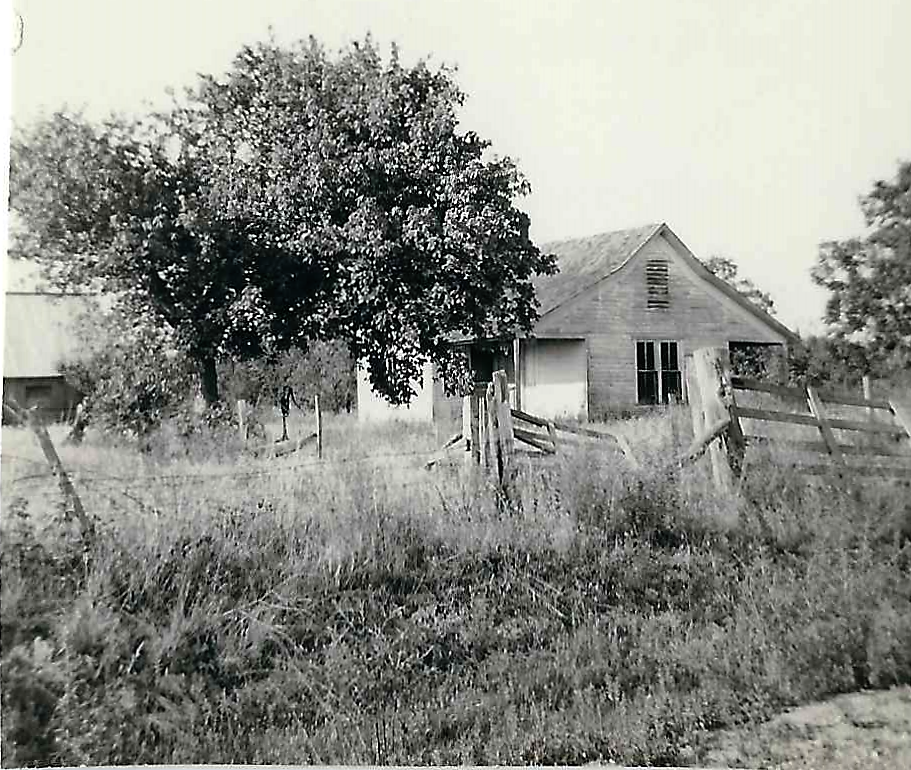
We did not stay long at the Earl Wilson place.  I am sure that my father was not at all happy working as a hired hand.  He found a fair-sized farm a few miles north of Bona near Fair Play, Missouri.  It belonged to a doctor named Hunt so we always called it “the Doc Hunt place.”  It had a small weathered farmhouse, smokehouse, well with a cast-iron pump in the yard, chicken house, and outhouse.  The grey weathered sprawling barn was pretty old, but my father made it do for the mismatched team of myules he got and for several milk cows.
Doc Hunt place circa 1952

While we lived on the Doc Hunt place I was about nine and Richard was eleven so we could start helping out around the place with chores.  We fed the chickens, split and carried wood, and sometimes helped with the milking.  I do not recall ever having been taught to milk a cow.  It seems like farm kids just know how to do things like that can be a mystery to city kids.  I guess we were getting practical lessons from Dad every day without ever realizing it.  We had a good tutor, too—Dad was a hard worker and he knew everything that needed doing around a farm.
Doc Hunt place circa 1952

One time it was a good thing that Richard and I knew how to milk.  Dad and Mother had taken Rex and gone in our old Model T to Bona, Greenfield, Bolivar, or somewhere.  They were not yet back when we got home from school—another one-room country school, Shady Grove, that we walked a mile and a half to get to. We knew exactly what to do about the evening chores so pretty soon we had everything done except the milking.  The problem with that was that Dad had been selling milk and we had about twenty cows that were demanding to be milked as the sun went down.  That is one whale of a lot of teats (eighty to be exact) to squeeze by hand!

When the sun was nearing the horizon, Richard and I knew those cows had to be milked so we got the buckets and a milk can and started.  When it got dark, we lit a kerosene lantern and kept at it.  Our small hand and arms got dog tired, but we stayed with it and were just finishing stripping the last two cows when the Model T finally pulled in.  I think they maybe had a flat tire or something that had delayed them in town.

Dad, who had been figuring that he would have to malk all those cows in the dark, was real proud of us for getting everything done and he said so.  That made us proud, too, but it was sort of embarrassing because usually he did not say much when were were right, but boy he sure let us know when we did wrong!  I guess that is how us boys grew up with the philosophy that a fellow does not need a bunch of praise for just doing what he is supposed to do.  Praise only came when you did something really outstanding—like two little boys getting all those cows milked.
Fair Play Store as it might have looked during the '20s & '30s

Tuesday, May 17, 2016

A Country Boy in the Big City


In Kansas City, my father took us to the first talking movie I had ever seen.  I do not recall the name of the movie, but it was at the Woodland Theater just beyond the fire station from our house.  I was fascinated when, at the beginning of the newsreel, a moving picture of a rooster crowed right out loud as if you were standing right near him in the barnlot!  Then, at the beginning of the main feature, the MGM lion roared.  I had to look in a lot of books to find out how they did that.


One important thing to Kansas City kids was the Saturday serial at the matinees.  You were not really “with it” at school unless you had seen the latest episode.  The whole time we were in Kansas City we went to see the serial “The Jade Box” on Saturday afternoons.  It was shown at a theater a few blocks beyond Faxon school.  We found out that on Saturday afternoons kids could get in for a can of food for the needy.  Sometimes we got in for just an egg and eggs were less than 25 cents a dozen even before the Great Depression set in the next year.
A scene from the Jade Box


We got quite fond of movies in Kansas City but, before long we were to move back to the country around Greenfield and Bona and we did not get to see many for several years—not until we moved back to Vancouver, Washington in the late thirties.


I never got to go to the plant where Dad worked but he told us that one of his jobs on the assembly line was to climb into each car body that came by and seal up under the dashboard with putty so rain would not leak in the seam.  It did not sound like much of a job to me and I decided that I certainly did not want to be an assembly line worker when I grew up.  I did not know yet what I wanted to be.  One time about then my father asked me about that and, according to him in later years, I solemnly said, “Well, I haven’t decided yet whether to be an outlaw or a preacher!”  I must have been pulling his leg as I do not recall ever wanting to be either of those.

One thing us kids liked about living in Kansas City was that we had an inside bathroom with white porcelain bathtub and toilet.  We did not have to take baths in a washtub by the kitchen stove and at night we did not have to go outside to a smelly old outhouse to go to the toilet.  We also had electric lights and my mother had a sink in the kitchen with hot and cold running water.  She had a gas cookstove so we did not have to split and carry wood.  There was an icebox on the back porch where an iceman put a block of ice whenever Mother put a card in the window saying how much she needed.


The icebox had no freezer to keep ice cream but we did not lack for it.  Each evening on weekends there were ice cream wagons that came slowly along the street.  They had bells on the wheels so you could hear them coming.  If you had a nickel or could talk your mother or father out of one, you ran out to the corner and the ice cream wagon would stop.

Monday, May 16, 2016

Goin' to Kansas City

Faxon School in Kansas City, MO where Conrad and Richard attended school during their time there. Fall of 2015 the building, which had sat empty for a decade, was turned into affordable housing for seniors.  Quite possibly its former pupils are now tenants.


In 1929 when I was seven, Dad got restless again.  He was not making it at the station and one of our many relatives in Kansas City, Missouri, told him he could get a job at the Fisher Body automobile plant there.  Dad did get a job on the assembly line for Chevrolet bodies and moved us to a two-story white house on the corner of 37th and Highland not far from where our Uncle Hubert and Aunt Ora Hayward lived.  
Aunt Ora was Dad’s eldest sisters.  Uncle Hubert, an inventor (the Hayward wrench was his design) and entrepreneur, was to die at a relatively early age in the mid-thirties and Aunt Ora reigned for years as the matriarch of the Kansas City bunch—which numbered at one time around seventy-five relatives of various degrees.  We never went to Kansas City in later years without without paying or respects to “Mama Ory.” [My only memory of Aunt Ory was at her funeral in the Bona Church.  Although Friezes left Bona and Dade County, most, including my dad, considered it home—forever.] Hubert and Ora had several children, some of whom I don’t remember much about, but I became close with Maude, one of the younger daughters.  Maude was a happy-go-lucky teenager when we lived there and I liked her very much.  [Although I probably met Maude when I was little and my parents took me to Missouri, I remember her from my visit to Greenfield in 1970.  She was still happy-go-lucky and excited about going to see Elvis.  Of the cousins of my dad that I met over the years, Maude is the one I remember best, heard him speak of the most often, and liked best.]
                The big city was quite a change for a couple of young country boys.  We went to Faxon School on The Paseo about four blocks from where we lived.  Faxon was big and bewildering after having gone to little one-room country schools with maybe a total of thirty pupils in all eight grades.  In those, each class took turns going to the front of the room to recite.  At Faxon, however, each class had a separate room, generally with as many children in it as we were accustomed to in a whole school!  I felt like a fish out of water for a while, but it did not take long to adapt.
When we started at Faxon, I was put in class 3B because of my age, but before long the teacher realized that they teach pretty well in those little country schools because I was ahead of everyone else in the class.  They jumped me one grade 3A and I felt good that once again I was just one grade behind Richard who was in 4A.  I was quite proud when I showed my new teacher that I could already do long division.  She embarrassed me because she was so delighted that she hugged me right there in front of the whole class.
One time at Faxon I was in an operetta as a wooden soldier.  A bunch of us little boys had to march to the music of “The Parade of the Toy Soldiers.”  We had to wear white pants, blue coats with white bands crossed over our chests, and tall black shako hats that our mother made out of stiff buckram.
I was confused and scared while we were lined up waiting to go on the stage.  I was afraid that all those people would just laugh at us and I wished that I could go away and hide.  When the music started and we marched on, I just tried to remember what the teacher told us about marching with stiff arms and legs.  The audience—mostly parents, I suppose—did not laugh.  They clapped for us and we marched off harder.  I suspect that we did not stay in step too well, but as we left the stage they clapped again and that made us feel good.  It left me with the beginnings of a feeling of confidence about getting up in front of people that was to stand me in good stead all of my life. 

Sunday, May 15, 2016

Chapter 2 and Race Relations

Abandoned gas station in Greenfield, MO


Chapter 2

Moves, Watermelons, & Rabbit Traps

Vancouver, Washington, and Arcola, Missouri were only two of the seemingly endless series of moves while my father searched for a living for us.  The years between 1928 and 1933 are a bit hazy, but I know that we moved often enough that us kids sometimes went to two different schools during the same school year.

                After Arcola, I am not sure if we went to Kansas City and then to Greenfield or the other way around.  Doesn’t really matter I guess, but I know that in Greenfield Rex was still pretty small.  That was when Dad ran a small service station beside the highway that runs from Greenfield to South Greenfield, Lockwood and on to Lamar.

                We lived in a house that was attached to the service station, such as it was.  It was just two tall glass-topped gasoline pumps—one for low test and the other for high test ethyl.  The Model T Fords used the low test (regular) and Chevrolets, etc., used ethyl.  On the side of the house there was a little room for oil, grease, fan belts, and the like.

                It is at this point that my father’s memoir becomes uncomfortable for me and I found it necessary to consider options of dealing with the place and time in which he was raised and the use of the “n-word.”  Missouri was a border state during the Civil War. Brother fought against brother.  Jim Crow and segregation lasted well into the 20th century.  Most Black families tended (and still do) to live in metropolitan centers, not rural Missouri.  Those who did are described as caricatures, not average people.  I fully support free speech and am four square against the banning of books.  Tom Sawyer and Huckleberry Finn need to be viewed from the lens of the time in which they were written so I wondered if my father’s use of that word and his memories of two Black men who lived in his community ought to be so viewed.  The issue came up in the summer of 2013 when Paula Dean used the n-word conversationally.  I don’t believe that any white person using that term means anything good by it and she has nothing of the same excuse.  At best it is paternalistic.  At worst it is outright racist.  My father’s little sister responded to my outrage by reminding me that my father had had a Black babysitter, “N-George” and my father liked him fine.  That was just what everyone called him.  Everyone?  Now I am pretty sure that George had a last name; probably the surname of whatever master had owned his forbearers, but it seems that it is lost to history.  I am sure that no white in Dade county wondered if George minded being called the n-word.  They may have assumed that he wasn’t intelligent enough or felt enough self-worth to mind.  After all, he was just a Black man. 

                I cannot lay claim to a Black experience in America, but I do know what it is like to be the mother of a special needs child and hear the word “retard” bandied about.  It doesn’t matter what you MEAN by the use of a word.  What matters is how it makes the recipient feel.  As a high school employee I would admonish students for calling each other or a situation “retarded” and remind them of my beloved daughter.  “I didn’t mean anything bad by it,” would be the response to which I said, “You didn’t mean anything good either.”  Calling George N-George may not have been intended to be hurtful, but that does not excuse the nastiness that goes along with the use of the n-word.  It is time that Paula Dean and her ilk owned their behavior and put themselves in the place of those for whom that word was intended to keep marginalized.

It mortifies me to say it, but wonderful man that my father was in many ways, he was a racist. As I said, he was a product of the time and place he was raised.  Later, extensive travel broadened his mind on many things, but in his memoir he does not mince words in describing the “negroes” that were a part of his childhood or their station in an already poverty stricken community. I believe in the power of words.  Therefore, when quoting my father’s memoir I will use “N-George” to suit my sensibilities if not my father’s.


                In the yard at one side, Dad built a wooden grease rack.  It was just two ramps to get the cars off the ground so he could get underneath and change the oil.  He painted the rack red.

                One reason I remember that grease rack is because of an old negro handyman everyone called “N-George.”  No disrespect was intended—that was just George’s name.  Everyone liked the old man.  He was a wizened Black man with snow white hair who did odd jobs for folks around town.  He did not work in the fields for two reasons—he was too old and he was deathly afraid of snakes.  Even a little garter snake like I sometimes carried around in my pocket would send George up the nearest tree.

                Sometimes the younger men would tease old George by throwing a piece of rope down by him and yelling, “SNAKE!” just to see him jump.  I thought that was pretty mean of them.  N-George was as good hearted and, so far as I know, as honest as any man.  He was always kind and gentle with us kids.  Could be that he was a mite lazy, but it did not show much as no one in the Ozarks moved around very fast.

                Well, to get back to that grease rack, when my mother needed someone to mind two-year-old Rex while he played in the yard.  If Rex started to go out into the road George would say, “Now yo’ come back here, boy!  You wants me to take this here switch to yo’ britches?”  Then old George would turn to anyone nearby and with a twinkle in his ancient brown eyes say softly, “Y’all knows I wouldn’t lay a han’ on that boy for nuthin’ in this hyere worl’l.”

                There was another negro in Greenfield that us kids liked real well.  I do not remember his name, but he was the fat old boy who was the local barbecue cook.  For want of better, I’ll just call him “Sam” because that may well have been his name anyway.

                Near the filling station there was a vacant lot.  Once in a while Sam used a pit there to barbecue a big piece of meat—I suppose for some doings in Black town (yes, it was commonly known as “N-town”) which was not far away across the highway and the railroad track.  Us kids would go by there and pester Sam when the meat was almost done.  He would pretend to chase us away, but we would always wind up with a slice of the outside brown part between two slabs of white bread with barbecue sauce and mustard.

                I do not remember if the meat was pork or beef but, if there turns out to be manna in Heaven like the preachers say, it will probably not taste any better than Old Sam’s barbecue did then to hungry boys.  I can still visualize him standing there with a white apron over his fat stomach threatening us with a barbecue fork in one hand and handing us a sandwich with the other.